How to brew tea without any equipment
Good tea doesn’t require fancy gear. This article is proof.
There is a particular kind of panic that sets in when you are a tea drinker in an unfamiliar place. Maybe you are in a hotel room with nothing but a kettle and a mug. Maybe you are working at the office today and forgot your infuser.
You have tea. You have hot water. You have nothing else.
Here is what most people do not realise. You do not actually need fancy equipment to brew good tea. Equipment makes brewing more convenient, more precise, and for certain brewing styles, more ceremonial. But the fundamental act of brewing tea is simply hot water meeting tea leaves and being given time to create its magic.
The rest, as they say, is details.
This guide walks you through every practical and equipment-free method of brewing tea, from the elegantly simple to the genuinely improvised, along with the situations each method suits best, and what to watch out for so your tea still tastes good.
First, a mindset shift
Before we get into the methods proper, it helps to unlearn one assumption that many tea drinkers carry: that leaves floating in your cup are a problem to be solved.
They are not.
During so many of our previous workshops, we’ve received the question of “what do I do with the leaves in my cup?” so many times. Our workshop participants are often shocked by how I would sip make my tea directly in a cup or mug and then drink directly from it. In fact, in much of the tea-drinking world, such as China, Tibet, across Central Asia, loose leaves in the cup are completely normal. The grandpa style of brewing (which we will cover shortly) is drunk by millions of people daily, including seasoned tea masters who own more tea ware than most people own shoes. They still choose to drink straight from the vessel, leaves and all.
The idea that tea must be strained before drinking is largely a Western concept, shaped by the mass market tea bag and the English tradition of pouring through a strainer into fine china. It is a preference, not a rule. Once you let go of it, equipment-free brewing stops feeling like a compromise and starts feeling like a legitimate method, because it is one!
Method 1: The grandpa style
Best for: Loose leaf teas of all kinds, especially green teas, white teas, and light oolongs. Also excellent for puerh.
You need: A mug, a cup, or any vessel. Hot water. Tea leaves.
Difficulty: Essentially zero.
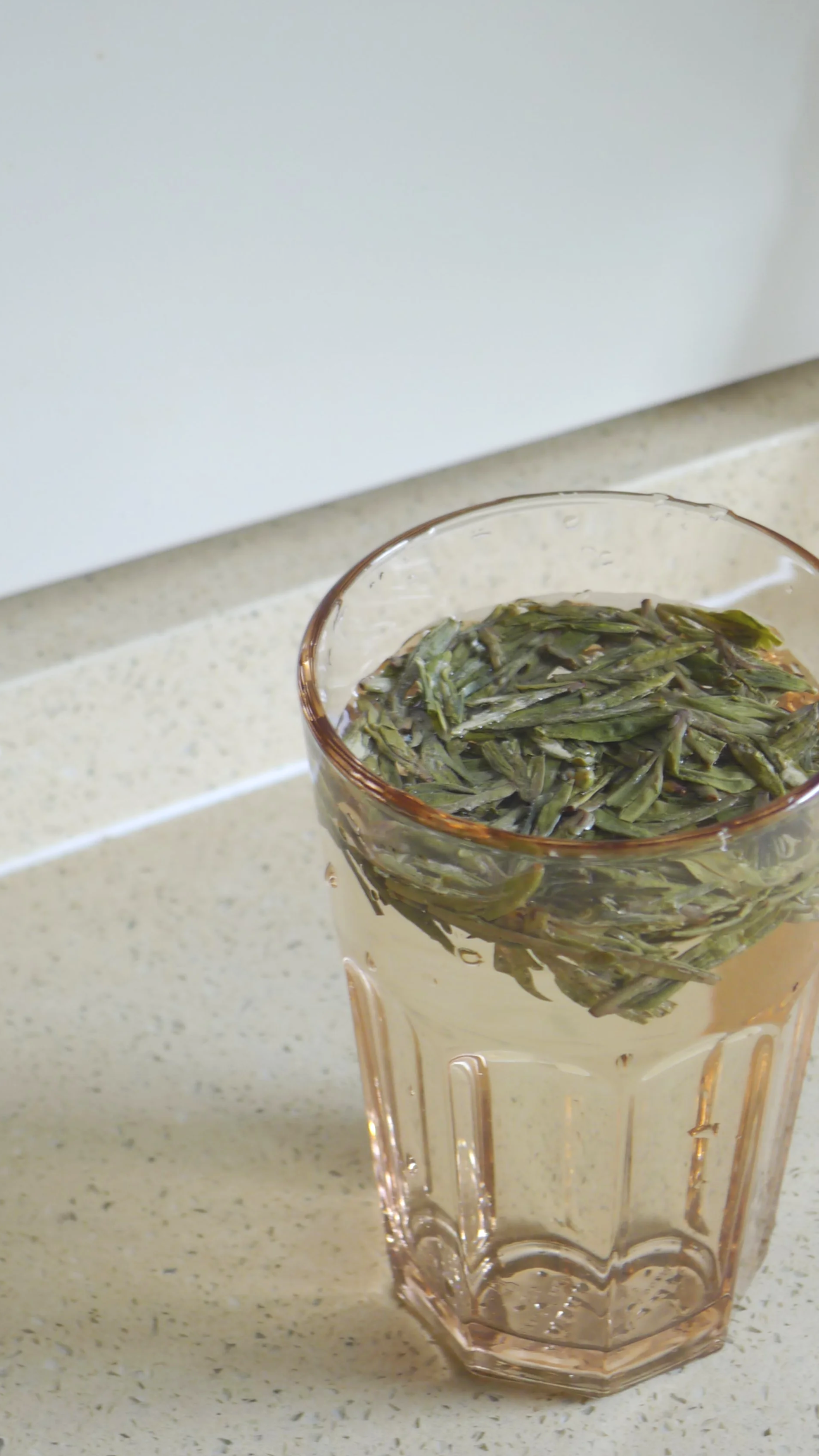
What it is: Named after the image of an elderly Chinese man with a large glass of tea and floating leaves that he sips throughout the day. This is the simplest possible way to brew tea. You put leaves directly into your cup, add hot water, and drink. When the water gets low, you add more. You do this all day. There is no steeping time, no straining, no protocol. The leaves live in the cup with you. It sounds almost too simple to produce good tea, but it really does not. In fact, the grandpa style can produce surprisingly nuanced flavours, particularly with teas that are forgiving of extended contact with water.
Our tea recommendations:
green teas that are light, forgiving, naturally sweet (especially Chinese green teas like Long Jing, Bi Luo Chun, Mao Feng)
white teas that are low in tannins, like Silver Needle or White Peony
light oolongs that are floral and gentle, like Taiwanese high mountain oolongs or Jin Xuan
young sheng puerh and shou puerh, as they are earthy, smooth, and can handle continuous steeping
whole leaf black teas, but use them in small quantities as they can become bitter
Teas to avoid:
broken-leaf tea or tea dust, as they release flavour too quickly and can turn bitter very fast
heavily rolled oolongs if used in large quantities
How to do it
Step 1: Choose your tea wisely. Not all teas suit grandpa style equally. This method works best with teas that do not become aggressively bitter or astringent with prolonged steeping.
Step 2: Use the right amount of tea leaves. Use lesser leaves than you normally would. As the leaves remain in water continuously, you want a lighter hand than you would use for a timed steep.
A rough guide:
2 to 3 grams of tea leaves for a 300 to 400ml mug (that’s about one teaspoon of most teas)
leaves will hydrate and expand gradually so do not worry if they look sparse
Step 3: Add water. Pour water directly over the leaves. Temperature is important (you may refer to this article).
Step 4: Wait briefly. Give the leaves 30 to 60 seconds to release flavour. Then sip from the side of the cup away from where most leaves have settled.
Step 5: Refill water as needed. When you are down to the last one third of the cup, refill with hot water. The tea will be lighter but often more nuanced in subsequent refills.
Step 6: Know when it’s done. When refills produce almost no colour and flavour, the leaves are spent.
Tips for getting the most from grandpa style
Tilt your cup. Hold your mug at a slight angle when sipping to let leaves drift to the far side.
Use whole leaves. The larger the leaf, the less likely it is to end up in your mouth.
Drink mindfully. Grandpa style rewards slow, attentive drinking. It is not a method for gulping. The flavour evolves as you drink, and the best way to appreciate is to pay attention.
Do not be precious about a leaf or two in your mouth. It’s just a tea leaf (as we like to put it, it’s technically like eating vegetables). Also, most tea leaves that are fully hydrated will sink to the bottom of the cup.
Method 2: The western mug steep (no infuser needed)
Best for: Any situation where you want a cleaner cup without floating leaves and you have two vessels available.
You need: Two mugs or cups, preferably with lids. Hot water. Tea leaves.
Difficulty: Very low.
What it is: This method replicates a standard Western-style steep without an infuser. You brew in one vessel, then pour the liquid through into a second vessel using the lid, or any small improvised barrier to hold back the leaves.
How to do it
Step 1: Place your tea leaves in one mug. Use the normal leaf:water ratio.
Step 2: Steep for the appropriate time. Cover the mug if possible to retain heat and aroma during steeping.
Step 3: Pour into the second vessel. Here is where improvisation comes in. Your goal is to let the liquid through while keeping the leaves back. If your mug has a lid (like some travel mugs), crack it open just enough to pour through while the lid holds back the leaves. You can also use a small plate or saucer over the mug to do the same.
Step 4: Drink from the second vessel. Refill the first brewing mug and repeat if desired.
Why two vessels matters
The moment you transfer your liquid away from the leaves, steeping stops. This is actually the fundamental principle behind all tea straining. You halt extraction at the right moment.
Method 3: The cold brew method
Best for: Hotel rooms, offices, travel. Anywhere with a bottle or jar and access to a refrigerator.
You need: A vessel with lid. Cold or room temperature water. Tea leaves.
Difficulty: Zero, but requires planning ahead.
What it is: Cold brewing requires no heat at all. You place loose leaves in cool or room-temperature water, seal the container, and leave it for an extended period. The tea extracts slowly, producing a smooth and naturally sweet cup with low bitterness.
Our recommendations:
green teas like sencha, gyokuro, long jing: these are very clean tasting teas that are sweet when cold brewed
white teas as they are delicate and floral
lightly oxidised oolongs
black teas with fruity notes
Less suitable teas:
heavily roasted oolongs (roasted notes are often not expressed when water is cold)
broken leaves or tea dust (extracts too quickly)
How to do it
Step 1: Place leaves directly in your container. Cold brew ratios are generally higher than hot brew. You can use 5 to 8g of tea per 500ml water. Adjust according to how strong you like your tea.
Step 2: Fill with cold or room temperature water. Cover the vessel.
Step 3: Leave to steep.
in the refrigerator: 6 to 12 hours (or overnight)
at room temperature: 3 to 6 hours
Step 4: Drink up!
Why cold brew works
Cold water extracts flavour compounds differently from hot water. It extracts far fewer tannins and catechins, the culprits responsible for bitterness and astringency. This means that cold brew teas are naturally smoother and sweeter.
What affects taste when brewing without equipment
Temperature is your most critical variable
This applies to all the above methods except cold brewing.
Without an infuser or timer to control the process, water temperature becomes even more important. if the water is too hot, you cannot compensate for extended steeping time. If the water is too cold, you will not extract adequately.
You can get acquainted with how water looks like at various temperatures, or put your hand against the rising steam to gauge water temperature (I do that sometimes, as I’ve obviously had made a lot of tea over the years and have learnt to gauge temperature based on how long the steam takes to heat up my hand). Memorise what boiling water looks like at different cooling stages. A rolling boil at 100°C looks different from water at 98°C. And in general, leaving the boiled water to sit for 5 minutes will bring its temperature down to about 80°C, so do the math and keep trying.
Leaf quality matters even more
With precise equipment, coaxing a reasonable cup from a mediocre tea is possible. But without equipment, the quality of the tea leaves carry most of the weight. Good quality loose leaf teas are way more forgiving. They extract more cleanly, handle variable temperatures better, and has a wider acceptable range of steeping times before becoming unpleasant.
This is actually one of the strongest arguments for investing in quality loose leaf teas. They perform consistently even in imperfect conditions.
Start with less leaf than you think
Without the ability to precisely time and strain, a conservative amount of leaves will give you more control. You can always steep longer for more strength, but you cannot unsteep over extracted tea.
A note on tea bags
If you find yourself without equipment but you have access to tea bags rather than loose leaf, all of the above becomes unnecessary. The bag itself is already a functional infuser. This guide is written for loose leaf drinkers, and the broader point stands: even without a tea bag, you are not helpless.
The tea bag was invented for convenience. However, for thousands of years before the tea bag was patented in early 1900s, people have been drinking loose leaf teas without straining. You are not improvising when without a tea bag, you are simply returning to how tea has always been drunk.
The takeaway
Good tea does not require good equipment. It requires good water, appropriate temperature, decent leaves, and a willingness to adapt.
The grandpa method is a legitimate centuries old brewing tradition that produces excellent tea when done with care, and we highly recommend trying. If anything, brewing without equipment is useful practice. It teaches you to pay attention to temperature without a thermometer, to read your tea’s flavour instead of relying on a timer, and to appreciate how forgiving good quality loose leaf teas actually are.
Your gear is a tool, but the tea does the real work.