How tea is made: from fresh leaf to your cup
Before tea reaches your cup it starts as a fresh, green leaf growing on a Camellia sinensis plant The leaf looks nothing like the dark, twisted, fragrant leaves you buy in a package. So what happens in between?
The answer is… processing! Every tea type (white, yellow, green, oolong, black, dark) comes from the same plant, and the only difference is how the leaf is treated after plucking.
In today’s blog post, we will walk you through the core steps that almost all teas share, and we will explore the unique regional methods that make Chinese, Japanese, Indian, Taiwanese, and other teas so different from one another.
The universal steps for common to most teas
Before we get into regional differences, these are the basic steps that almost every tea goes through.
Step 1: Plucking (harvesting)
Workers (or sometimes machines) pick the tender young leaves and buds from the tea plant. The standard for high-quality tea is “two leaves and a bud”, which is the terminal bud and the two youngest leaves beneath it.

During hand plucking, skilled workers carefully select only the best leaves. This is slow, expensive, and used for fine teas.
During machine plucking, a large hedge-trimmer-like machine shears the top of the bush. This is faster and cheaper, but older, coarser leaves are included in the harvest.
Not all tea leaves are created equal. Two leaves plucked from the same bush on the same day can produce dramatically different tea if one is plucked at dawn and the other at noon.
Tea plants, like all plants, perform photosynthesis during daylight hours. This daily cycle directly affects the chemical composition of the leaves.
Here’s what happens to a tea leaf over 24 hours.
early morning (dawn to 9am)
leaves are still damp with dew
plant has been resting all night
sugars and amino acids (including L-theanine) accumulated in the leaves overnight
higher natural sugars means subtle sweetness without added sugar
higher L-theanine means more umami, smoother taste, less bitterness
lower in tannins, so leaves have less astringency and bitterness
leaves are tender, so they are easier to roll without breaking
cooler temperature slows onset of oxidation
highest moisture content
best for high-quality tea
ideal for white, green, light oolong tea
late morning (9am to 11am)
dew has evapourated
plant has been photosynthesising for a few hours
sugar levels remain good, but some amino acids have been used for growth
good for most teas
common harvesting window
balanced flavour
mid day to early afternoon (11am to 3pm)
photosynthesis is at its peak
plant produces more tannins and catechins (bitter compounds) as natural sun protection
leaves are drier and tougher
lower quality for delicate teas
acceptable for bold black teas where bitterness is less noticeable or even desirable
late afternoon (3pm to sunset)
plant has been stressed by heat and sun all day
tannin levels are at their highest
leaves begin to recover slightly as temperatures cool
not ideal for harvesting
some large-scale plantations harvest here for volume, not quantity
night
no harvesting occurs
leaves are too wet with dew and condensation
excess moisture leads to mould during withering

The season of harvesting also impacts the quality of tea leaves greatly, which we have covered extensively in this article on the life cycle of a tea plant.
One other factor that affects a tea leaf’s quality is the way it is handled after plucking. After plucking, the tea leaf remains alive for a while. It respires, oxidises, and bruises (more on this below).
Step 2: Withering
Freshly plucked leaves are tough and full of water (about 70 to 80% moisture). They are spread out on large troughs or bamboo mats, often with fans blowing air over them.
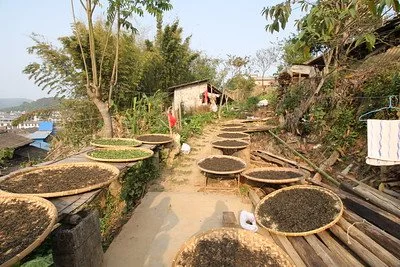
Source: Santo Chino
Water evaporates. The leaves darkens slightly and become soft, floppy, and limp. This takes about 8 to 18 hours. About 30 to 50% of water weight is loss.
Withering makes the leaves more flexible. This flexibility is important as it ensures that the tea leaves can be rolled without breaking. Withering also concentrates flavour compounds and begins the chemical changes that lead to oxidation.
Step 3: Rolling (shaping and bruising)
The withered leaves are now rolled, twisted, or pressed. This can be done either by hand (the traditional way) or by machine.
Rolling breaks the leaves’ cell walls, releasing enzymes and juices that were previously separated inside the leaf. These compounds then come into contact with oxygen, kickstarting the process of oxidation. Through rolling, the leaves take on its final form (for example, as twisted strips, curled balls etc).
Chinese teas are usually rolled by hand in large bamboo trays or by machine in a twisting motion. This produces long, twisted, or curly leaves.
Japanese teas are usually rolled into thin, needle-like shapes.
Oolong teas are usually lightly rolled, allowed to rest, then rolled again, and this process is repeated many times. This creates the tight, ball-shaped oolongs commonly seen in Taiwan and Fujian.
Step 4: Oxidation
This is the most important step that separates tea types. Have you ever noticed that your sliced apple turns brown? The same chemical process changes tea leaves in significant ways.
When polyphenols in tea leaves react with oxygen in the air, the tea leaves darken, forming new flavour compounds. Tea makers manage oxidation by controlling temperature, humidity, and time.
In white, yellow, and green teas, very little oxidation occurs. In oolong teas, the amount of oxidation varies from oolong to oolong. For black teas, the tea leaves are fully oxidised.
The colour of tea leaves can act as a good gauge to how much oxidation has occurred. This is why white teas generally appear to be pale green to slightly brown, green teas and yellow teas appear to be green, oolongs can range from green to dark brown, while black teas look dark brown or even black.
Step 5: Fixation (or kill green)
At the exact moment the tea maker wants oxidation to stop, they apply intense heat to kill the enzymes that cause oxidation. This freezes the flavour profile in place.
Kill green is a loose translation from the Chinese term sha qing (杀青).
Here are two examples of fixation:
Chinese pan-frying
leaves tossed in hot wok or rotating drum
produces nutty and toasty notes
used for most Chinese green teas and some oolongs
Japanese steaming
leaves blasted with steam
produces bright green colour
produces vegetal and umami flavours
used for almost all Japanese green teas
Step 6: Drying
After fixation, the leaves still contain about 15 to 20% moisture. They are dried in hot air ovens or over charcoal fires until moisture drops below 5%.
The leaves now become brittle, shelf-stable, and develop their final aroma. Drying also locks in the shape achieved during rolling.

Some teas are dried twice, once immediately after fixation, then again after a final shaping or sorting step.
Step 7: Sorting and grading
The dried leaves are sorted by size, shape, and quality.
This is done so by a few ways:
sifting
leaves are passed through screens with different mesh sizes
broken leaves and tea dust are separated from whole leaves
by colour
machines or workers remove discoloured or burnt leaves
grading
leaves are labelled by grade (OP, BOP, TGFOP etc - specific definitions can be found in our tea glossary!)
Regional production methods
Now that you understand the universal steps, we’ll now look at how different regions apply (or skip) each step to create their iconic teas.
China

China is the birthplace of diverse methods as she produces every type of tea, from white to dark. Each has its own tradition
Chinese green tea
Key characteristics:
pan-fried
nutty
toasty
Unique steps:
withering is very short (2 to 4 hours)
leaves are barely wilted
fixation is done in a hot wok
workers constantly toss the leaves by hand
for Longjing tea, this is done in a large wok at 250 to 300°C
rolling and fixation happen during fixation
heat softens the leaves while worker’s hands shape them into flat pieces (Longjing) or tight spirals (Bi Luo Chun)
drying is done in the same wok by using low heat after fixation
Chinese oolong
Key characteristics:
partial oxidation
complex aromas
multiple rolling
Unique steps:
long withering (8 to 16 hours) and leaves lose 30 to 40% moisture
tossing (or shaking or 摇青, yao qing) of leaves in large bamboo trays
edges of leaves bruised and gets oxidised during tossing
resting stage (or 作青, zuo qing) whereby leaves rest 1 to 2 hours
bruised edges turn red while centers stay green
tossing and resting stages repeat 4 to 8 times over 6 to 16 hours
oxidation stopped at desired levels (light: 10 to 20%, medium: 30 to 50%, heavy: 60% to 85%) using pan-firing
ball shaped oolongs have their leaves wrapped in cloth and rolled into tight balls, then unwrapped and dried, then wrapped and rolled again
rolling is repeated 5 to 10 times
Chinese black tea
Key characteristics:
fully oxidised
often has smoky or malty notes
Unique steps:
thorough withering that takes 10 to 16 hours
aggressive rolling to press and twist leaves heavily to break cell walls
broken cell walls ensure full oxidation
oxidation is uncontrolled
leaves are spread in a cool and humid room for 2 to 4 hours until they turn completely copperish brown, then dark brown
no fixation as oxidation runs to completion
leaves go straight to drying using hot air of 80 to 90°C
Chinese white tea
Key characteristics:
minimal processing
no rolling
no fixation
fine white hairs on buds remain intact
Unique steps:
long and gentle withering that takes 48 to 72 hours
leaves spread thinly on bamboo mats, indoors, or in very light shade
leaves are occasionally turned
no rolling, no bruising of leaves
no fixation, no heat used to stop oxidation
oxidation continues extremely slowly throughout withering
drying is at very low temperatures of 40 to 50°C for several hours
delicate flavours preserved
leaves continue to age slowly over time
Chinese yellow tea
Key characteristics:
rare!!!!!
like green tea but with an extra yellowing step to remove grassiness
Unique steps:
follow the same steps as green tea (withering, fixation, rolling
additional yellowing step (or 闷黄, men huang)
yellowing = after fixation and rolling, the slightly damp leaves are wrapped in paper or cloth and stacked in a warm humid room for up till a day
leaves slowly turn yellow as chlorophyll breaks down
grassy flavours mellow into sweet and nutty notes
yellowing step is hard to control
Chinese dark tea
Key characteristics:
post-fermentation (microbial ageing)
NOT an over-oxidised black tea
Unique steps for raw puerh:
short withering of 2 to 4 hours
kill green is performed while leaf is still green to stop oxidation
gentle rolling
leaves are spread out and dried under the sun to keep microbes alive
steaming to soften leaves so that they can be pressed into cakes and bricks
stored for years in controlled conditions to help the tea age
microbes ferment the leaves
a young raw puerh is bitter and astringent, but as it transforms into an aged puerh, it turns smooth and sweet
Unique steps for ripe puerh:
same initial steps as raw puerh (withering, kill-green, rolling, sun-drying)
wet piling (or 渥堆, wo dui) whereby leaves are piled into large 1 to 2m tall mounds
mounds sprinkled with water and covered with cloth
pile heats up naturally to about 50 to 65°C
leaves turned every few days to accelerate fermentation
fermented leaves are then spread out to dry
dried leaves are pressed into cakes
further ageing improves flavour
Japan

Japanese teas are distinctive because they are generally steamed and not pan-fried. They are sometimes shaded before harvest.
Japanese green tea (unshaded, such as sencha)
Key characteristics:
steamed
bright green colour
grassy and vegetal flavour
Unique steps:
short withering, sometimes even skipped
goes through steaming (or 蒸し, mushi)
fresh leaves are put into a steam chamber for 15 to 60 seconds to kill enzymes and fix green colour
steaming time determines the tea’s character
light steam (or 浅蒸し, asamushi) produces light green liquor that is delicate and floral
medium steam (or 中蒸し, chumushi) makes the standard sencha that is balanced
deep steam (or 深蒸し, fukamushi) breaks leaves into fine particles and produces a dark green liquor that is thick and not astringent
leaves go through cooling and primary drying to remove surface moisture, by being blown with cool air
rolling is in multiple stages to twist leaves into thin, needle-like shapes
leaves are first rolled into thick twisted ropes
then pressed and twisted into thinner needles
then shaped and dried simultaneously
leaves go through a final drying using hot air of 80 to 100°C
Japanese shaded teas (unshaded, such as gyokuro, kabusecha, matcha)
Key characteristics:
shaded before harvest
high umami
low astringency
Unique steps:
has a shading step that is unique to Japan
light is reduced to 10 to 20% of the normal intensity
shaded tea plants produce more L-theanine (umami note) and lesser catechins (bitter notes)
Gyokuro and tencha (for matcha) are made from tea plants covered with shade cloth for 20 to 25 days prior to harvest
Gyokuro is rolled like sencha but more gently to preserve the tender leaves
Tencha is not rolled, stems and veins are removed after steaming, and the remaining pure leaves are ground into matcha powder using slow-turning granite stone mills
a single stone mill grinds 30 to 40 grams of matcha per hour
slow speed prevents heat from damaging the delicate flavours and from becoming too bitter
Kabusecha is made from tea plants covered with shade cloth for 10 to 15 days
Japanese lower grade teas
Bancha is made from larger and older leaves harvested after sencha
processed like sencha
lower umami and more astringent
Kukicha (twig tea) is made from stems and twigs left over after sencha or gyokuro processing
lightly steamed and dried
low caffeine, nutty, sometimes slightly sweet
Hojicha is Bancha or Kukicha roasted at high heat after normal processing
leaves turn brown, has lesser caffeine, has toasty notes
roasting replaces final drying step
Genmaicha is sencha or bancha blended with toasted brown rice
rice is roasted separately then mixed with the finished tea
India

India produces two distinct styles, the orthodox (traditional, whole-leaf teas) and CTC (crush-tear-curl for tea bags and chai).
Indian orthodox tea (like Darjeeling and Assam orthodox)
Key characteristics:
similar to Chinese black tea processing
Unique steps:
withering is long and takes 12 to 18 hours in large troughs with fans
Darjeeling uses cooler temperatures of 20 to 25°C to preserve delicate flavours
rolling step twists leaves into strips
rolling is done gently to avoid breaking delicate leaf structure
leaves are oxidised by spreading on cement floors or table in a cool, humid room for 2 to 4 hours
Darjeeling oxidation is intentionally left incomplete (80 to 90%) to preserve floral and muscatel notes
Assam oxidation runs to completion (100%)
hot air of 85 to 95°C is used to stop oxidation
leaves go through sorting and are sifted into grades (FTGFOP1, TGFOP, BOP etc)
China variety tea bushes used in Darjeeling produce smaller and more aromatic leaves than Assam bushes
Indian CTC tea (Crush-Tear-Curl)
Key characteristics:
machine made
small pellets
very fast and strong brewing
consistent flavour
perfect for tea bags and masala chai
less nuanced flavours
Unique steps:
shorter withering (6 to 8 hours), keeping leaves more moist
no rolling step
leaves are fed into CTC machine, where two large ridged rollers are rotating in opposite directions at different speeds
CTC machines crush the leaves, then tears them into small fragments, and the curls the fragments into small tight pellets
pellets are spread for 1 to 2 hours for them to oxidise
as leaves are torn into tiny pieces, oxidation happens very quickly
leaves are then dried with hot air of about 90 to 100°C for 20 to 30 minutes
Taiwan

Taiwan is famous for her ball-shaped, lightly oxidised, high mountain oolongs. This production method is unique to Taiwan.
Taiwanese high mountain oolong
Key characteristics:
tightly rolled balls that slowly unfurl when brewed
creamy texture
floral aroma
Unique steps:
long withering of 12 to 18 hours in cool mountain air
high altitude teas wither more slowly because of lower temperatures
goes through tossing like for Chinese oolongs, done 4 to 8 times over 8 to 12 hours
fixation by pan-firing at 250 to 300°C for 3 to 5 minutes to stop oxidation at a very light level of 10 to 25%
after fixation, the still-warm leaves are wrapped tightly in a cloth bag
bag is twisted and pressed into a tight ball
leaves are dried slightly, unwrapped, then wrapped and pressed again
repeated 5 to 10 times over hours
every repetition tightens the ball shape and extracts juices to the leaf surface
tightly rolled balls are then finally dried in hot air ovens
Taiwanese Oriental Beauty (Dong Fang Mei Ren)
Key characteristics:
bitten by bugs
naturally sweet like honey
no roasting
Unique steps:
tea deliberately grown without pesticides
tea jassids (tiny leafhoppers) bite the leaves
plant responds by producing sweet, fruity compounds to attract predators of the leafhopper
only leaves that show insect damage are plucked (they have silvery white tips with red edges)
very long withering of 2 to 3 days to develop honey notes
leaves are gently rolled into strips
high oxidation of 60 to 75%, where the leaf edges turn bright red and centers stay dark green
no roasting and drying is done at low temperature to preserve delicate honey aroma
Taiwanese roasted oolongs
Key characteristics:
heavier oxidation
roasted
nutty
Unique steps:
same initial steps as high mountain oolongs (withering , tossing, fixation, rolling into balls)
additional roasting (烘焙, hong pei) where leaves are roasted at 80 to 120°C for several hours to several days
creates nutty, caramel, toasty notes and reduces moisture
some roasted oolongs are aged for years
ageing mellows the roast and adds complexity
Sri Lanka
Key characteristics:
orthodox black tea, very similar to Indian orthodox
Unique steps:
long withering of 14 to 18 hours in warm and dry air
rolling using rotorvane machines
oxidation carried out in cool humid rooms for 3 to 4 hours
drying with hot air
tea from Ceylon has different flavours when grown on different elevations
low grown (below 600m) produces bold and full bodied flavours
medium grown (600 to 1200m) produces balanced and smooth flavours
high grown (above 1200m) produces Nuwara Eliya, with light, floral, and citrusy flavours
Nepal (Himalayan Tea)

Key characteristics:
orthodox black tea, very similar to Darjeeling (China-variety, high altitude)
many Nepalese teas are made in small batches with hand-processing by small, artisanal producers
lighter oxidation with more floral notes
delicate Napalese white tea more common now (and they taste great!)
Vietnam

Key characteristics:
diverse production methods, use a range of Chinese, Japanese, and other local methods
Vietnamese green teas are often pan-fired but often brewed strong and served with ice
Vietnamese oolongs similar to Taiwanese ball-shaped oolongs as many oolong producers were trained in Taiwan
Vietnamese black tea are both orthodox or CTC and often used in blends
Lotus tea, which is green tea scented with fresh lotus flowers, is made by placing lotus flowers overnight in lotus flowers to absorb fragrance
Thailand

Key characteristics:
similar to Taiwanese style oolongs (high mountain ones from Doi Mae Salong, Doi Wawee)
many Taiwanese tea farmers settled in northern Thailand after World War II and brought their oolong methods
Northern Thai mountains have altitudes of 1000 to 1500m that are suitable for high mountain oolongs
light oxidation and ball shaped
Korea

Key characteristics:
Korean green teas are sometimes steamed and sometimes pan-fried
Some tea producers use a combination of both metods
historically, Korean teas were steamed in bamboo steamers
lightly roasted after drying to give them a nutty, toasty note
Ujeon (first flush) Korean green tea is the most prized
plucked before April 20th of each year and processed by hand
Indonesia

Key characteristics:
mostly orthodox black tea, some green tea, and increasingly oolong
many tea plantations follow traditional Dutch era processing methods due to Dutch colonisation in the past
high altitude black teas from Java and Sumatra are smooth and mild
Indonesian green tea is sometimes scented with jasmine flowers
The soul of the leaf
A Longjing master can feel when the wok is at the right temperature without a thermometer. A Japanese tea maker can smell when the steaming is complete. A Taiwanese oolong roller knows by touch when the cloth ball is tight enough. You now know the steps of plucking, withering, rolling, oxidation, fixation, and drying. It is not just a beverage but also an art, passed down across centuries, one leaf at a time.